CX and marketing: what stays the same and what is dramatically changing

Recently, an interesting headline landed in my inbox—great customer experience (CX) is the best retention tool. But when I opened the email, it didn’t really talk about customer experience anymore. Instead, it focused on customer care.Customer care is, of course, an important part of CX—but it’s definitely not the same thing. Customer experience isn’t just about the purchase, unboxing, product usage, or handling complaints. It’s about the entire customer journey.
Try searching for “customer journey” in Google Images and you’ll see countless visualisations. Most of them show several stages—from awareness to consideration, purchase, product usage, and beyond. Consultants at McKinsey looked at these models and concluded that reality isn’t quite that simple. There must be some kind of trigger at the beginning. Then comes initial consideration, comparison of alternatives, and the purchase decision. And if the post-purchase experience is positive, future purchases may happen automatically—without much deliberation.

People at Google, however, argued: “Yes, there is a trigger at the beginning—but the middle part isn’t linear. It’s actually quite messy.” We often go back and forth, reconsider options, and experience doubts. That’s how the concept of the messy middle was born.

Whichever model you choose, it’s important to remember that it is—well, just a model. In reality, 95% of your customers are currently outside of any customer journey. They are in a passive phase, focused primarily on their own lives—not your brand.
So what are they doing instead? If we look at media consumption data, we see something surprisingly consistent: people are watching, listening, scrolling through social media, reading, and playing games. What is changing dramatically, however, is where they do it. In terms of time spent, social media has been in first place since 2016, while linear TV has been gradually declining. At the same time, streaming—whether video, music, or podcasts—continues to grow.

And when it comes to social media: should we still even call it “social”? Increasingly, these platforms are taking on the role of traditional media, where people spend time and follow celebrities.

All platforms are essentially becoming new TV channels—and video dominates everywhere.

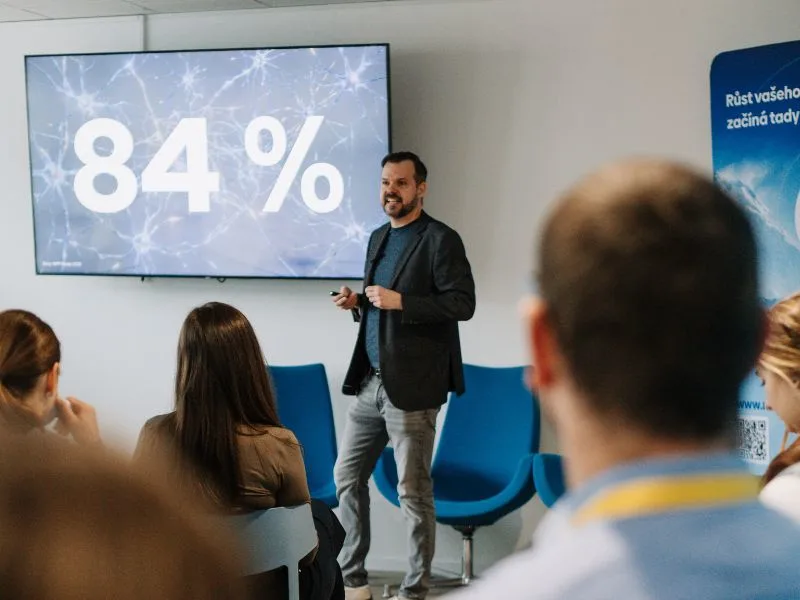
So what happens when people move from the passive phase to an active one? This is where brands still play a huge role. According to this year’s WPP Media study, in 84% of purchases people already have a clear brand preference—before they even start shopping.
And this number doesn’t change much across categories—whether low-involvement (like beverages or dental care) or high-involvement (like cars or luxury goods).
This is closely linked to how much people are influenced by marketing communication. Across the entire audience spectrum, about a quarter of people are largely resistant to communication, while roughly 10% are highly susceptible. The majority sits somewhere in between. In other words: most people will only engage with your communication lukewarmly. And if it’s not immediately clear who you are and what you offer, they won’t bother to look for more information.

When we look at channel impact, recommendations, reviews, and one-to-one communication carry more weight than campaigns. Are you leveraging them enough?
And what happens further along the customer journey? Years ago, Al Ries and his daughter Laura published a book about the fall of advertising and the rise of PR—which didn’t fully materialise. Today, however, the conversation might shift toward the rise of AI.
The latest Ketchum research on trust in different channels confirms that personal recommendations are the most trusted. They are followed by comparison tools and search engines. AI chatbots come next, with 18%—already surpassing traditional advertising and influencers.

What do people use AI for? About 45% use it to understand a topic, nearly half to compare alternatives, and just over 40% to learn about experiences with products or services.
But let’s move further. What does CX actually look like in the Czech Republic? It’s improving year by year, according to KPMG’s annual study. However, empathy still lags behind.

One brand that consistently ranks among the top is Rohlík. One of the reasons is its empathetic approach to complaints. This can significantly strengthen brand relationships—according to statistics published in Harvard Business Review, more than 70% of initially dissatisfied customers are happy to repurchase if their issue is resolved satisfactorily. This is known as the service recovery paradox.
Another important concept in the usage phase is the peak-end rule. The peak of a restaurant visit is the meal itself. But the end is the payment—and if something goes wrong there, if the process is slow, complicated, or unpleasant, it can ruin the entire experience.
Or you can end on a high note. Take Dishoom, a chain of Indian restaurants in the UK, where guests can roll a dice at the end of their visit. If they roll a six, their entire bill is free.

And if the headline “magical matka” sounds confusing, it helps to know that “matka” refers to a form of illegal gambling from the 1960s in India—perfectly fitting the restaurant’s theme.
So how do we approach such a complex topic as CX at Marketup? It starts with a clear brand strategy and the integration of brand and customer experience. The brand—its personality and rituals—should be an integral part of the experience.
Next comes mapping the entire customer journey and benchmarking it against competitors. Based on that, you can identify weak points to fix, as well as amplify “wow moments”—those moments where you exceed expectations and strengthen the connection to your brand, applying the peak-end rule.
So what does all this mean for you and your brand?
What stays the same:
People still watch videos, listen to audio, and read—but the media itself is changing
Brands still matter—a vast majority of purchases (on average 84%) are driven by pre-existing brand preferences
Personal recommendations based on positive customer experience remain the most trusted and impactful “channel”
Even though customers are more demanding, they are still willing to stay loyal if problems are handled well (service recovery paradox)
What is changing:
All media is becoming digital—linear TV is declining, while social media, online video, Connected TV, and streaming (music and podcasts) continue to grow
Artificial intelligence is reshaping how people search for information about brands—trust in AI already surpasses traditional advertising and influencers; people use it to explore topics, compare options, and evaluate experiences
Customer experience (CX) in the Czech Republic is improving every year, but empathy still lags behind—focusing on solving customer problems can significantly strengthen relationships
Related articles